How to Keep Cats & Kittens Cool in Summer
 On the one hand, summer is very nice, because I like it warm, but on the other hand, too hot weather is quite exhausting. Especially for our furry roommates. That’s why I’m going to show you a few tips today on how you can make things more comfortable for your cats and give your cat a little cooling off.
TIP 1: TOWEL ON THE BACK
The first tip actually comes from dear friend Annika, and I would not like to withhold it from you in this collection, because I think it is quite effective. All you need to do is to dip a dish towel into cold water, wring it out well and lay it carefully over your cat. This way the cat will cool down a little bit from the outside.
TIP 2: GET YOUR HANDS WET
Your cat thinks the first tip is totally stupid and can’t have it at all if something is lying on her back? Then your cat feels similar to Nala and Flash. They can’t stand it either. But there is a simple solution for that as well. I always make my hands wet and then wash them through their fur (of course in combination with extensive crawling and stroking). This has a similar effect as the wet cloth on the back, but Nala and Flash find the method much more pleasant. If necessary, this procedure can of course be repeated several times a day.
TIP 3: COLD TENT
This one comes from an article on www.petcatfriends.com. If your cat avoids any contact or you would like to have something longer-term, then I recommend the “cold tent”. For this purpose we bought a small clotheshorse, which is actually placed over the bathtub. But it can also be used for other purposes! In summer we always put it in the living room or in the kitchen on the floor, moisten a big, thick towel with cold water and put it over the clothes horse. Already the cold tent is ready! Your cat can now lie down under it and enjoy the slightly cooler air that radiates from the damp towel. If the towel dries slowly, you can simply wet it again, wring it out and put it back over the clothes-horse. Your cat will thank you!
EXTRA TIP: Alternatively you can also build something like this with other tools. A towel over the transport box (if it’s made of plastic) or over a (garden) chair will do it as well. There is no limit to your creativity. The main thing is to create a kind of cave and the cool air can penetrate inside.
TIP 4: FAN
Tip number 4 also provides cool air, for which you will need a fan and – how could it be otherwise – a towel. It should be as light and thin as possible, otherwise it will be too heavy when wet. Just hang the towel in front of a fan and turn it on. It blows through the towel and the cool air is distributed throughout the room. By the way, this is not only a great tip for cats, but also for people
TIP 5: COOLING MAT
You mean cool air is overrated anyway? Then maybe the cooling down from below would be something for you or your cats? There are special cooling mats with gel filling for dogs and cats, which cool down slowly under the weight of the animal and thus offer a pleasant underlay on hot days. The practical thing about them is that you neither have to put them in the freezer beforehand nor connect them to the electricity. Just lay them out and you’re done! And if you don’t want to invest the money for them, you can imitate such a cool mat again with a damp, cool towel. But be careful that the underlay is “waterproof” and that you don’t have the towel lying on your parquet floor or similar all day long.
TIP 6: PADDLING POOL
For playful and curious cats, water games are particularly well suited. Here you can either be creative yourself or use prefabricated variants from the pet shop. On Instagram, I have noticed that many cats are totally into the “Kitty Pool”. Here your cat can happily splash around in the water and fish for the floating toys that are included. Since Nala and Flash are not so much water rats, we haven’t been able to gain any experience with this, but I think it can be a lot of fun for cats.
TIP 7: CAT ICE
We had more success with a similar “toy”. As I said before, you are also allowed to be creative yourself and we did that. Since I know that Nala and especially Flash are more likely to be lured out of their reserves with food than with toys, we occasionally serve tuna ice cream in the “cat pool” – our casserole dish. Just mix some tuna with water and fill it into an ice cube form or alternatively take the tuna juice directly and freeze it. When everything is well frozen, we pour some water into the casserole dish and add some of the ice cubes. The water makes them slide back and forth more easily, so the cat is busy longer and has to do more for her treat. And by the way this has the effect that it is always very funny and sweet to look at for us humans.
FUN FACT: In the course of our photo shooting for this article we also tried to throw some treats into the water and that worked even better than with ice cream! Flash went fishing for treats like crazy, splashed all over the room and obviously had a lot of fun (and so did we while watching). And it has the advantage that he d
rank the whole time, hoping he could get the treat.
TIP 8: DRINKING
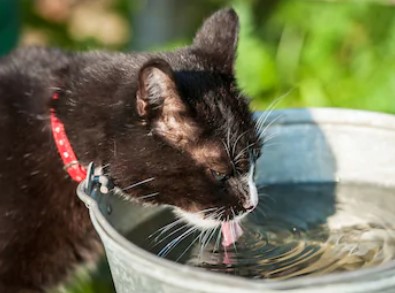
Last but not least, the only tip that actually remains is the one that applies equally to all creatures: drink plenty of fluids to avoid dehydration! Provide sufficient drinking bowls with fresh water or even better a drinking fountain*. This provides cats with fresh, filtered water all the time and encourages them to drink by moving the water. However, if your cats are as lazy as Nala, you can simply mix some water into their daily food to make sure they get enough moisture. If she doesn’t, this can cause serious health problems.
KEEP COOL
As you can see, there are a lot of ways in which you can give your cat a little cooling – both internally and externally. If you know any more tips and tricks, please write me!
Here are some more tips you can try!
7 Common Cat Behavior Questions

They coo like pigeons or chase their own tails – sometimes the behavior of our cat seems mysterious or even crazy. In most situations, however, there are logical explanations. You’ll see today that it’s usually not so difficult to interpret.
1) Why is my cat scratching at the bowl?
As a cat owner, you may have seen your pelt-nosed cat scratch the floor with its paw in front of the bowl, or even try to cover the bowl with a blanket or something similar.
We laugh at this seemingly pointless behavior – after all, scratching on tiles has no effect – but for our velvet paws, covering the feeding area is an innate instinct.
Because wild cats bury the leftovers after eating to hide them from predators.
2) Why do cats not like closed doors?
Your cat wants to get out and as soon as the door is closed behind him, he wants to get back in? Most cats can continue this game forever. But what sometimes drives us crazy is perfectly logical behavior for the cat. This has to do with the fact that cats like to have an overview of their territory at all times. If the access to a room is denied for a while by a closed door, the velvet paw has to check immediately if everything is still ok. There is only one thing to do: leave the room doors open.
3) Why is my cat cooing?
 Why do cats coo in their sleep? Besides meowing and purring, most cat owners hear another sound from their cats: cooing. When cats coo like pigeons, it can have different meanings. First of all, you can take this sound like a proof of love, because on this level cats only talk to their favorite people.
The cooing is then either a greeting or an invitation to pet, play or feed. Even if you wake your cat up from sleep, she may still coo – but this is a sign that you should let her sleep in peace.
4) Why do cats clean their humans?
If your cat brushes you occasionally, it’s a sign of affection at first. In cat language, this means that your cat is concerned about your welfare and accepts you as part of her social structure. On the other hand, this can also mean that she wants to change your smell. Have you petted another animal before? Or put cream on your hands? Then your cat wants you to return to your usual smell, or preferably her smell.
5) Why do cats wiggle their bums before they attack?
Another curiosity always makes us laugh. When cats start to jump during a game, they wiggle their butts just before the game. This droll behavior is due to the cat’s hunting instincts. Shortly before it pounces on its prey, the cat is extremely tense. The head and ears are silently directed towards the target. But the velvet paw moves her bottom before the jump. This shifts her weight from one leg to the other to find the perfect balance for the jump and landing.
6) Why do cats bitch or chatter their teeth?
When cats fixate on their prey, they sometimes make a very peculiar sound that can be described as a chattering or biting sound. Some cats only show this behavior when they watch a bird through the window; others even chatter at flies and other insects. The explanation lies, as so often, in the predator genes of our house cat. For it is now generally agreed that the chattering is only a secondary noise that occurs when the cat tries its deadly bite into the spinal cord of the prey shortly before the attack. Our cats are in the core just nevertheless dangerous robbers.
7) Why do cats prefer to go to people who do not like cats?
Guests in the cat household: Miezi unerringly steers towards cat haters and allergy sufferers, while skilfully ignoring anyone who tries to pet them. To the cat allergy sufferer, this probably seems to be pure malice. But the real reason can be found in the language differences between humans and cats. If we want to establish contact, this happens first by eye contact, speeches, and gestures. So what do we do? Staring into the cat’s eyes, talking to it and reaching out to it. All this means for your cat that the human is looking for a confrontation. The direct eye contact is usually understood by your cat as a threat – the velvet paws fight for power through eye duels. She prefers to look for a quiet place. And where would she rather find it than with someone who doesn’t want to know anything about her?